



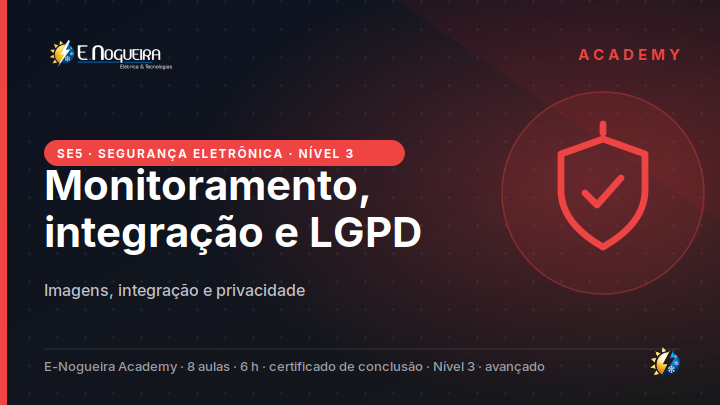

Remote monitoring, integration and LGPD for video images
Technical trades

Remote monitoring, integration and LGPD for video images

0.0
(0 Ratings)
E-Nogueira
Created by E-Nogueira
$45.3

What you will learn?

Choose the remote access path for each client (P2P, DDNS, VPN), knowing the risk of each one, and recognize when the internet provider uses CGNAT.
Apply a 12-point checklist against intrusion: passwords, users, 2FA, firmware, disabled services and a separate security network.
Integrate alarm, cameras, access control and automation through dry contact, PGM and events, with a tested cause-and-effect table.
Configure notifications with few false alarms, video verification and a clear routine for whoever monitors.
Build the recurring service offer: self-monitoring, maintenance and partnership with an authorized monitoring center, with a contract, SLA and price per point.
Comply with the LGPD for images: legal basis, layered notice, retention, data subject requests, sharing and incidents.

About this course

You already install cameras and alarms. This course teaches what comes after handover, and what makes the client pay every month. First, remote access: how the app reaches the camera through P2P, DDNS, an open port or a VPN, the risk of each path, and the checklist that prevents hacked cameras (passwords, 2FA, firmware, separate network). Then, integration: an alarm that makes the camera record and send an alert, plus gate, floodlight and siren in scenes tested line by line, in a complete example of a shop with 8 cameras. You will tune notifications until only what matters is left and build the routine for whoever does the monitoring. You will understand what the law calls monitoring as a service (Brazil's Private Security Statute), what you can sell on your own, and how to build a one-page contract with an SLA and a price. Finally, you apply the LGPD to images: legal basis, notice, retention, data subject requests, handover to the police, and incidents. The LGPD is Brazil's data protection law; if you work elsewhere, use your local law (for example the GDPR in the EU or the CCPA in California) in the same places. This is not legal advice and not certification of a monitoring center.

Requirements

Have completed SE2 (or be able to install and configure IP cameras with an NVR, the network and basic remote access). SE3 (Alarms and sensors) helps in lessons 3 and 4; SE4 (Electric fence and access control) helps with the access control part of lesson 3.
Access to a real system or a bench setup: an NVR with alarm input and output, an alarm panel with a PGM output, and a 12 V auxiliary relay.
A phone with the NVR app and a laptop to reach the router and the NVR.

FAQ

Not on your own. Monitoring other people's security systems as a service is private security under Law 14,967/2024 (regulated by Decree 13,012/2026) and requires Federal Police authorization. Lesson 6 shows what you can offer without that authorization (installation, maintenance, support for the client's self-monitoring) and how to work together with an authorized monitoring center.
Yes. Lessons 1, 2, 5, 7 and 8 were written for you too: how to see the cameras on your phone without exposing the business, what to demand from the installer, how to respond when the police or a customer asks for footage, and what the LGPD asks of your shop.
No. It shows what the LGPD, the Private Security Statute and the Consumer Defense Code ask for in field practice, and it provides technical templates for a sign, a retention policy, a terms of use and a one-page contract. Contracts and cases involving biometrics should go through the client's lawyer or yours.
They are illustrative ranges for the interior of the state of São Paulo in 2026. Lesson 6 teaches you to calculate your own price from hours, travel and margin. The ranges only serve to check that your math makes sense.
No. Menus change from manufacturer to manufacturer. The course teaches what to look for in any equipment: alarm inputs and outputs, PGM, users, schedule, detection filters and the event log.

Comments (0)

P2P, DDNS, open port and VPN: the risk of each path
30 Min
Passwords, 2FA, firmware and separate network: the anti-intrusion checklist
30 Min
Module 1 quiz
5 Questions
Module 1 task
Alarm, CCTV and access: events, triggers and actions
30 Min
Automation and scenes: lighting, siren, gate and alert
30 Min
Module 2 quiz
5 Questions
Module 2 task
Smart notifications, video verification and routine
30 Min
Monitoring center or self-monitoring: contract, SLA and price
30 Min
Module 3 quiz
5 Questions
Module 3 task
LGPD for images: legal basis, notice, retention and the data subject
30 Min
Images for police and third parties, incident and manual
30 Min
Module 4 quiz
5 Questions
Module 4 task
Final quiz
10 Questions
Final project — Monitoring ready to sell

Certificate

Official certificate

0.0
0 Reviews
Content quality
0
Instructor skills
0
Purchase worth
0
Support quality
0
$45.3

Report course

Please describe about the report short and clearly.

Share

Share course with your friends